Orange County International Raceway (Irvine)
Nothing leftNothing left No longer racing, and nothing of the track remains.
Also known as the Super Track; the County; OCIR
- Birthplace of the Manufacturers Meet for touring Funny Cars
- Kenny Bernstein won the Last Drag Race in 1983
- Its three-story tower and fan amenities set a new standard for drag strips in 1967
- Raced
- 1967-83
- State
- California
- What's left
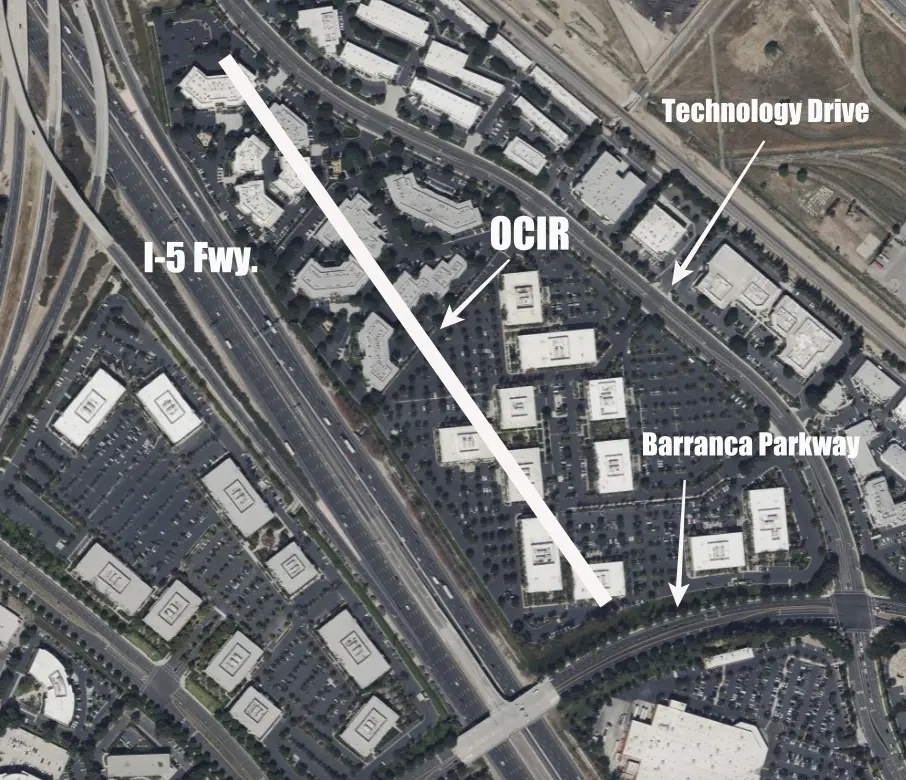
- The site was redeveloped and nothing of the strip remains.
- On the site today
- Irvine Co. industrial park
- Raced on
- Built as a drag strip
- First race
- August 5, 1967
- Last race
- 1983 (the Last Drag Race)
- Track
- 1/4 mile (4,200-foot track)
- Location
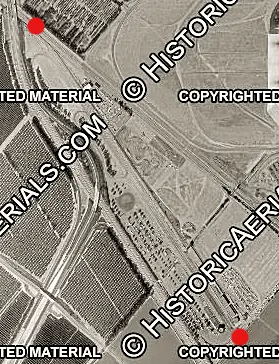
- East Irvine, inside the Y where the Golden State and San Diego freeways meet, near the Sand Canyon exit on I-5
- People
- Bill White, co-founder and president (1967)
- Larry Vaughn, co-founder, secretary-treasurer, later leaseholder
- Mike Jones, co-founder, designer, vice president and general manager (1967-73)
- Mike McKenna, financial backer
- Jim Tice, AHRA president who ran the track (1973-74)
- C. J. 'Pappy' Hart, general manager (1973-74)
- Larry Huff, operator (1974-75)
- Bill Doner, operator (until 1980)
- Steve Evans, operator
- Charlie Allen, owner and operator (1980-83)
- Sanction
- AHRA, NHRA
- Elevation
- 225 ft (69 m)
- Coordinates
- 33.66173, -117.74795
Orange County International Raceway ran from 1967 through 1983. Phil Burgess wrote a detailed history of it for Dragster Insider in 2008, when the track had been gone eight years longer than it was open. It was billed as ’the Super Track,’ and when it opened on August 5, 1967 the billing held up. Burgess compared the stir it caused to the reaction to Bruton Smith’s then-new zMax Dragway.
Longtime NHRA Vice President Bernie Partridge brokered the partnership behind it. It joined Larry Vaughn and Bill White, who grew up on the 80,000-acre Irvine Ranch and saw it as a good open site, with Mike Jones, a former designer and draftsman then working as a racing engine designer who had raced at the drags, the dry lakes and on road courses, and Jones’s financial backer, newspaper publisher and auto dealer Mike McKenna. Jones had first tried to bring drag racing to Anaheim’s new Angels ballpark, which the city wanted to earn more from after losing its bid for an NFL team, but the ballpark and drag racing didn’t mix. The Irvine Co., which held the land and planned housing and entertainment for an expected boom, had already turned down bids from Carroll Shelby and Jim Hall and from White. White as president, Vaughn as secretary-treasurer and Jones as vice president and general manager won the company over by promising a stylish, comfortable facility with landscaping and striking architecture, not just a strip and pits. They brought in five Orange County investors: Carroll Cone of Cone Chevrolet, investment banker David Brant, Raymond Martin, who ran amusements at O’Neill Park and Irvine Park and once owned a midget track, and Irvine Co. stockholders Mrs. Myford Irvine and Mrs. David Brant. The project was first budgeted at $80,000. The Irvine Co. gave them a 55-year lease in east Irvine, inside the Y where the Golden State and San Diego freeways meet.
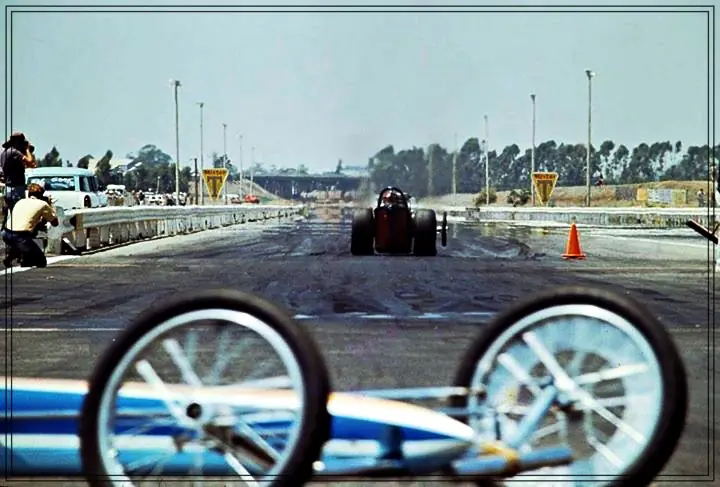
Jones drew the design, mixing his own ideas with NHRA advice and the best features of other tracks. In the opening-season program he wrote that racing could only keep growing if its facilities matched the professional standing of the drivers and cars, and that OCIR aimed to be professional and exciting but comfortable. It had permanent restrooms and concession stands, underground utilities, a restaurant, a speed shop, a playground, a starting-line scoreboard and a 40-foot, three-story tower holding the offices, the timing and announcing deck and a top-floor suite. Fans got drinking fountains, plenty of trash cans, turnstiles to keep the gates moving, covered arcades, reserved seats with backs and extra legroom. The track was 75 feet wide and 4,200 feet long, with a 300-foot sand trap ending in water-filled plastic barriers. Jones hired Marines from the El Toro air base who were trained in crash and fire rescue, gave the safety trucks the best gear available and arranged emergency plans with ambulances, hospitals, doctors and insurers in advance. His team spent months studying other tracks and running mock races on different layouts, and at one point the track was set to run the opposite direction.
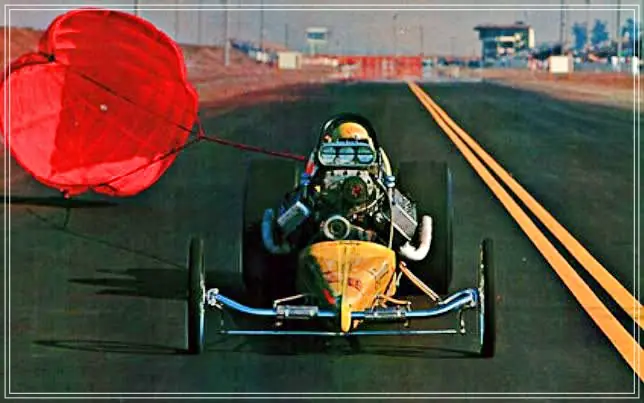
The Orange County Planning Commission approved the project on November 9, 1966, and NHRA and the Irvine Co. held a joint press conference the next day at the Irvine Information Center. Ground was broken February 15, 1967, grading began March 13 and the first racing surface was poured July 10. The whole thing cost nearly $750,000. Bill Holland, a future National Dragster editor who then ran a top fueler with John Guedel, remembered being impressed on opening day. He said the track took cues from Disneyland, with usherettes seating fans and good crowd control, rollers in the pits to warm up cars, and scoreboards and reaction timers that were new to the sport, and that many racers ran personal bests. Tom ’the Mongoose’ McEwen drove the Guedel & Holland/National Automotive Specialties dragster that day, set low ET at 7.02 and reached the final, where he red-lighted against Bobby Tapia in Larry Stellings’ car. Guedel set the track speed record of 223.88 mph at a Division 7 points meet later that year.
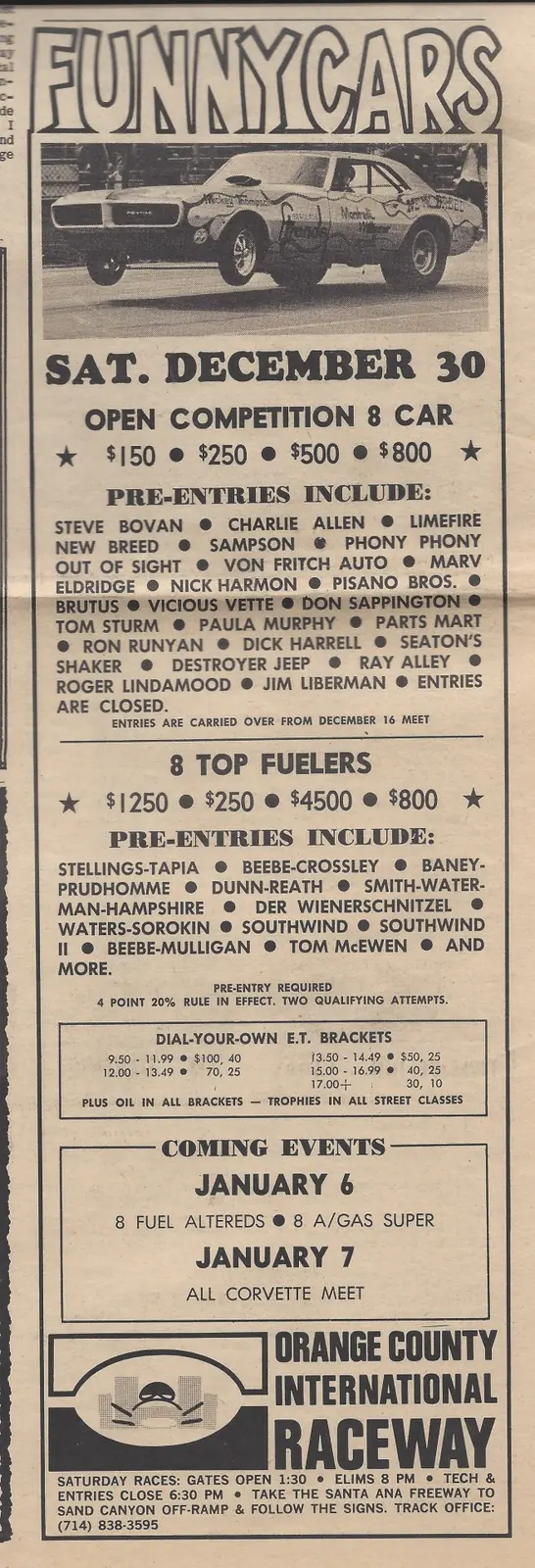
Lions Drag Strip in Wilmington and Irwindale were each less than half an hour away, and early competition was stiff. Jones built a program heavy on Funny Cars, created the Manufacturers Meet that gathered the country’s touring Funny Cars, and came up with lining the Funny Cars along the track before eliminations as a photo opportunity. He also built an air-conditioned pressroom with duplicating machines, phones, telex and a snack bar. In a 1969 Drag News interview he said sports editors knew competition but not drag racing, couldn’t be sold staged or booked-in shows as major events, and would stay away from the sport if racers or track managers misled them. Business at the gate improved when Lions closed after 1972, but OCIR still struggled. In its first two and a half years property taxes rose 400 percent, insurance went up 15 percent in 1968 and 21 percent in 1969, and trash fees doubled, while racers wanted bigger purses.
The track opened under NHRA sanction. After Jones left in July 1973 it signed a five-year deal with AHRA. AHRA President Jim Tice hired C. J. ‘Pappy’ Hart, a Lions and Santa Ana veteran, as general manager. Hart’s short stay included OCIR’s first national event and ended in his resignation after clashes with Tice’s staff. Tice walked away during 1974, leaving track manager Blaine Laux in place, and on June 1, 1974 Larry Huff, a millionaire businessman, Pro Stock driver and Funny Car owner, took over and kept the AHRA sanction. Huff had also taken over Tice’s Fremont Raceway. He dropped Fremont first and then OCIR in March 1975. By then motocross and speedway tracks and a defensive-driving school had been added, and there were plans to put spare land to commercial use to cover rising costs, but the Irvine Co. said no. The long lease, which could have run to 2022, went back to the Irvine Co., which wanted the now valuable land for commercial and residential use. Vaughn, the last of the four founders still involved, got a five-year deal to keep leasing it.
Bill Doner and Steve Evans of International Raceway Parks came next and returned the track to NHRA. Doner’s loud promotion and Evans’s steady management worked for a while before things got out of hand. Rock concerts were staged along with the races, and the yearly Fox Hunt let women in bathing suits in free, with Evans telling them on the radio to bring their bikinis. Drunk, rowdy crowds followed, and in the worst incident a 24-year-old man died after being hit in the head with a beer bottle. Longtime starter Larry Sutton recalled that the Doner and Evans years were always a spectacle with too many people and too little security, and that at one race he saw people sitting on the guardrail all the way down the track.
By 1980 Doner was tired of fighting city and county officials and wanted to retire to Mexico and go sport fishing. Partridge stepped in again and paired him with former Funny Car racer Charlie Allen, whose All-American Boy cars had run at OCIR, including on opening day, and who had been meeting opposition trying to build a track in Fontana. Allen bought Doner’s assets and the rights to the property and spent $300,000 to $400,000 on a partial facelift. He admitted to mistakes as a new track operator, but he wanted to bring back a family atmosphere. The next three seasons were among the track’s best. Families came back, and Allen, general manager Lynn Rose and track manager Kenny Green ran eight to ten major events a year, including the Manufacturers Meet, the 64 Funny Cars race and the Summer Showdown.
The lease was due to run out after 1982. Early that year Allen learned that the Irvine Co. president answered every letter he got, so he had TV and radio stations and the Orange County Register run stories about losing the track and urged fans and racers to write. At one point the president was getting 300 to 500 letters a day. He called Allen in and asked him to make it stop. Allen did, and the company came off well for granting one more year. Announcer Mike McClelland said the closing was on everyone’s mind. Early in 1983 work began on the first road other than Moulton Parkway (Irvine Center Drive) across the strawberry fields on the far side of I-5, and when the Alton Parkway bridge over I-5 started going up, he knew the track was finished.
That last season went well. Allen ran two 64 Funny Cars races on back-to-back weekends and made the second look like a last-minute decision, though he’d already bought the airtime and recorded the ads. He even closed the gates early so he could say people had been turned away. Doner loved it. Allen looked for land nearby to rebuild, but most of it was so hilly that grading alone would have cost $4 to $5 million. The Irvine Co. began building its long-planned industrial park, laying big water lines in the parking lot that had to be barricaded during events, and Allen had agreed not to slow the development. In return the company let him take anything he could salvage. He had started building Firebird International Raceway near Phoenix in 1983 and got bids on moving the tower there, but the cost was far too high. He said the success of OCIR’s final years is what made him want to stay in the business and build Firebird. By coincidence, Firebird Lake covers 113 acres, the same size as the OCIR parcel.
Kenny Bernstein won the Last Drag Race. His shop was nearby and he tested at OCIR often. He called it one of the great places to race, with a long run of great Funny Car races, and the last of its kind still standing. He compared its loss to the pro football teams leaving town, and said he still looked over at the site every time he passed the Sand Canyon exit on I-5. The tower stood for more than a year while construction went on around it. Photographers Don Gillespie and Mickey McIver shot it with its windows broken by vandals and a plywood sign over the front doors saying the track was closed and it was all over. Then it was torn down too.
Video
More in California
- Nothing left No longer racing, and nothing of the track remains. Alta Airport (Orosi) 1957-59
- Nothing left No longer racing, and nothing of the track remains. Antelope Valley Drag Strip (Palmdale) 1958-59
- Active Still racing today. Bakersfield Drag Strip (Famoso) 1952-present
- Closed No longer racing, but some of the track is still there. Ballico Airport 1959-62
- Active Still racing today. Barona 1/8-Mile Drag Strip (Lakeside) 2003-present
- Closed No longer racing, but some of the track is still there. Bishop Drag Strip 1963-68, 1974
- Closed No longer racing, but some of the track is still there. Brotherhood Raceway Park (Terminal Island) 1976-84, 1993-95
- Closed No longer racing, but some of the track is still there. Buchanan Field Airport (Concord) 1949
- Closed No longer racing, but some of the track is still there. California Dragway/Auto Club Dragway (Fontana) 2002-20
- Nothing left No longer racing, and nothing of the track remains. California State Fairgrounds (Sacramento) 1958-60
- Nothing left No longer racing, and nothing of the track remains. Carlsbad Raceway 1964-2004
- Closed No longer racing, but some of the track is still there. Champion Speedway (Brisbane) 1970-79