Motion Raceway (Assumption)
ClosedClosed No longer racing, but some of the track is still there.
- First drag strip in the country surfaced with Goodyear's Pliopave rubberized asphalt
- The Jones brothers auctioned their farm equipment and cattle to fund the track
- Drew Garlits, Prudhomme, Glidden and Muldowney
- Raced
- 1970-83
- State
- Illinois
- What's left
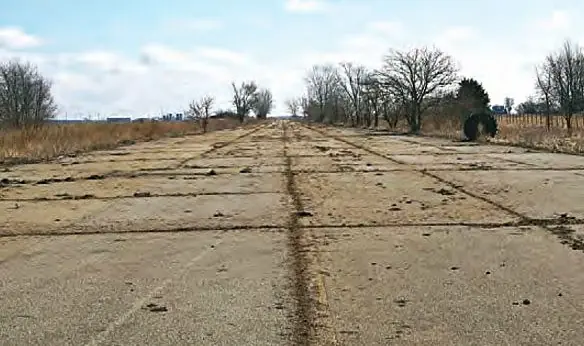
- A good length of the old track surface is still there, in poor to good condition.
- On the site today
- Grain storage
- Raced on
- Built as a drag strip
- First race
- November 8, 1970
- Track
- 1/4 mile, cut to 1,000 feet in 1979 (3,000 feet overall, plus 320 feet added in 1980)
- Surface
- Rubberized asphalt (Goodyear Pliopave)
- Location
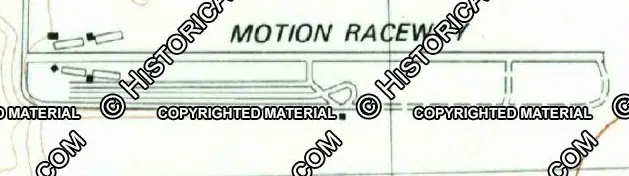
- Three miles north of Assumption, a mile west of U.S. Route 51
- People
- John Jones, builder, owner and operator (1970-)
- Paul Jones, builder, owner and operator (1970-)
- Dan Daniels, feature show booker, Raceway Promotions (1972)
- Jeff Gaines, operator (early 1979)
- Sanction
- AHRA, IHRA, NHRA
- Elevation
- 621 ft (189 m)
- Coordinates
- 39.56472, -89.05129
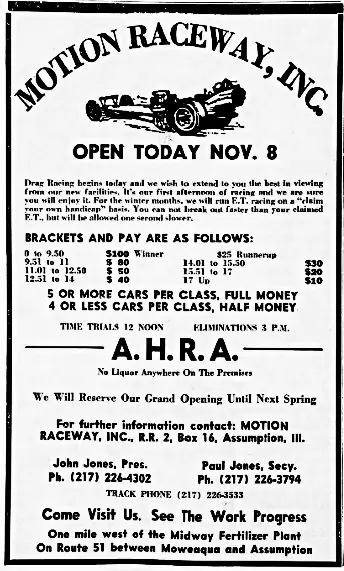
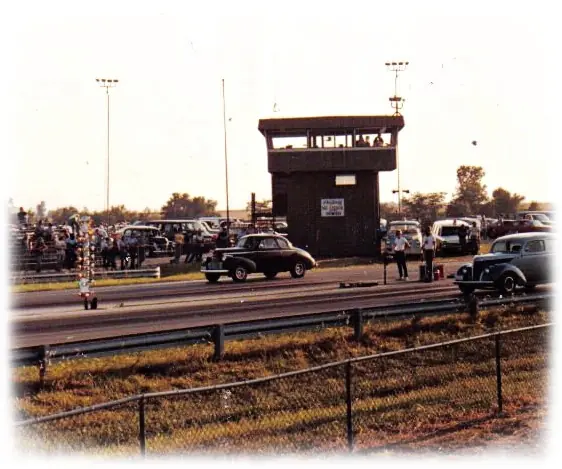
Brothers John and Paul Jones built, owned and ran this strip on John’s farm, three miles north of Assumption and a mile west of U.S. Route 51. At first it was very informal, with a coin-operated gate so anyone could race when they liked. After visiting a few organized strips, John decided to build a real track. The $180,000 track was finished in late 1970 and held its first race, under AHRA sanction, on November 8, 1970, with Sunday afternoon racing through the winter when weather allowed. It was surfaced with Pliopave, a rubberized asphalt made by Goodyear, and was the first strip in the country to use it.
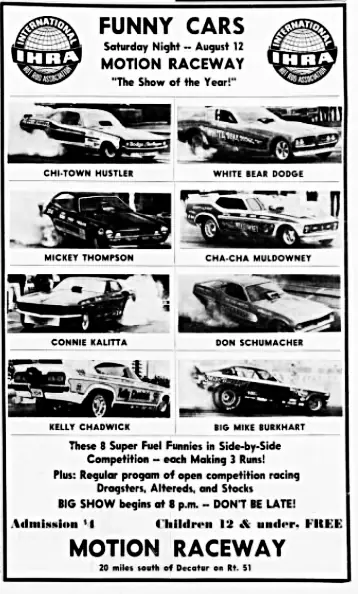
On January 28, 1971, the brothers held what ads called the largest closing-out sale in Illinois, auctioning their farm equipment and Angus herd to put more money into the strip. January and February were too cold to race, so racing started in March, and a grand opening on April 8, 1971, matched the “Chi-Town Hustler” against Terry Hedrick’s “Super Shaker.” Headliners that first full season included Tommy Ivo, Bob Perry’s “Fugitive” wheelstander, Della Woods, Paula Murphy, and the jet dragsters of Dave Corey and Fred Sibley. Weekly headliners burned through their money, so in July they cut to one big show a month. Paul Jones said a show every week didn’t work well, and the regular program drew because people came to see drivers they knew, averaging 146 drivers a week. Attendance ran about 2,000.
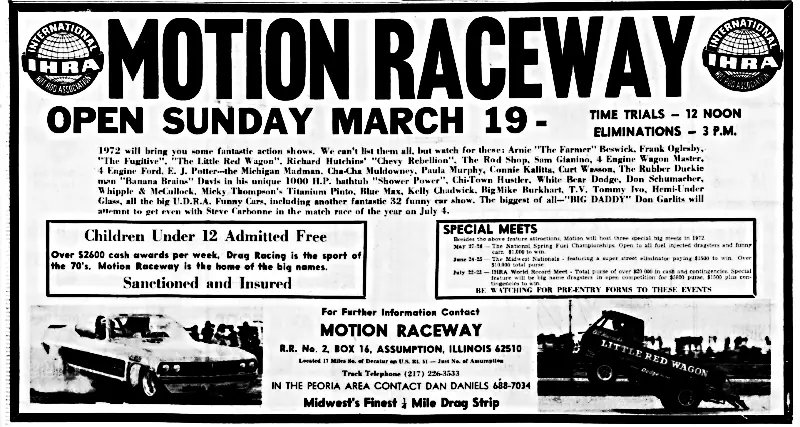
In 1972 they switched to IHRA and hired Dan Daniels of Raceway Promotions to book features. That August they spread a secret sand and rubber sealer on the track to improve traction. Bad weather and poor crowds left them $50,000 in the red for the season by August, and with $325,000 invested they wanted out, asking $400,000. They were still running it when 1973 opened. Paul Jones said they hadn’t tried hard to sell, and nothing came of the inquiries. They moved to bracket racing, cut payouts and held one big show a month, which kept feature costs down, and the track made money in 1973.
Jeff Gaines took over operations in early 1979, but the brothers took it back in June. The strip was built as a quarter mile, but its 3,000 feet proved too short for faster cars to stop safely, so racing was cut to 1,000 feet in 1979. An extra 320 feet of asphalt in 1980 earned it NHRA sanction that year, and over its life it ran under AHRA, NHRA and IHRA. Racer R. L. Steel, who ran his 1955 Chevy there, called it the best hooking track he ever saw, the first place he saw the car up on its back bumper for two gears. Don Garlits, Don Prudhomme, Bob Glidden and Shirley Muldowney were among the big names who raced there. Reasons and rumors for the closing vary. John Jones said he had simply lost interest and wanted to go back to farming. Farmers have used it for grain storage for years, though it ran a temporary, limited grudge racing schedule in 2008.
Video
More in Illinois
- Closed No longer racing, but some of the track is still there. Alton Dragway 1958-72
- Closed No longer racing, but some of the track is still there. Beardstown Drag Strip 1967-1979 or early 1980s
- Nothing left No longer racing, and nothing of the track remains. Camp Ellis (Canton) 1953-56
- Status unknown Closed, but nobody has checked how much of the site survives, or the exact spot was never found. CMW Dragway (Paris) 1971-74
- Active Still racing today. Coles County Dragway (Charleston) 1966-present
- Active Still racing today. Cordova Dragway/Quad City Drags 1956-present
- Nothing left No longer racing, and nothing of the track remains. Fairfield Drag Strip 1966-73
- Closed No longer racing, but some of the track is still there. Greater Peoria Dragstrip/Boondocks Dragway 1957-mid 1970s
- Closed No longer racing, but some of the track is still there. Greene County Fairgrounds (Carrollton) 1958-59, 1961-63
- Nothing left No longer racing, and nothing of the track remains. Half Day Speedway 1952-53
- Active Still racing today. I-57 Drag Strip/Ellis I-57 Drag Strip (Benton) 1972-present
- Nothing left No longer racing, and nothing of the track remains. International Amphitheatre (Chicago) 1962-64