Louisiana International Raceway Park (Eunice)
ClosedClosed No longer racing, but some of the track is still there.
Also known as Acadiana International Raceway Park; Acadiana International Raceway; Louisiana Raceway Park
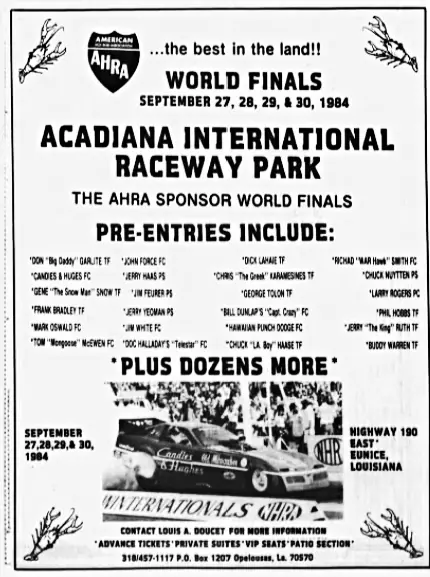
- Hosted the 1984 AHRA World Finals, where Don Garlits set a 257.14 mph AHRA record
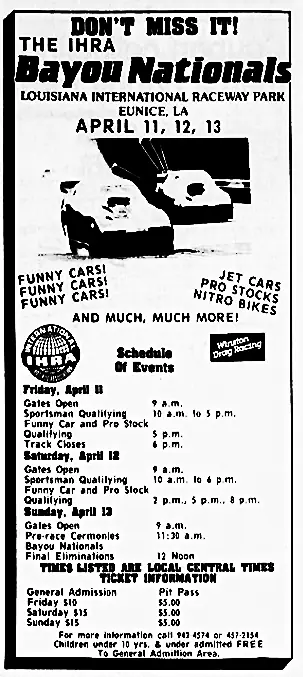
- First IHRA Bayou Nationals held April 11-13, 1986
- Built on a former quarter horse track, with stables turned into racer garages
- Raced
- 1984-2006
- State
- Louisiana
- What's left
- A good length of the old track surface is still there, in poor to good condition.
- On the site today
- Sold for development
- Raced on
- Built as a drag strip
- First race
- September 2, 1984
- Last race
- 2006
- Track
- 1/4 mile
- Surface
- Asphalt over a 6-inch concrete bed, with a 180-foot concrete starting pad
- Location
- Site of the old Lindzay Downs horse track, just west of Opelousas
- People
- Louis Doucet, founder, later sole owner (1982-1987)
- Russell J. Stelly, owner (1987-)
- Harold Dupre, owner (1987-)
- Gary Carter, track manager (1987-)
- Sanction
- AHRA, IHRA
- Elevation
- 51 ft (15 m)
- Coordinates
- 30.51490, -92.30954
One online source says this quarter-mile track opened in 1986, but that date is wrong. Louis Doucet and a dozen investors bought the old Lindzay Downs horse track in October 1982, and Doucet filed incorporation papers for Acadiana International Raceway Park on February 3, 1984. In May 1984, before the strip was even paved, he announced the AHRA World Finals for late September. A shakedown race on September 2 drew 3,000 people, and the track opened as Acadiana International Raceway.
The four-day AHRA World Finals ran September 27-30, 1984, with a strong pro field. Don Garlits set an AHRA world record of 257.14 mph beating Gene Snow in the semifinals, then beat Chris Karamesines for the Top Fuel title. In Funny Car, Mark Oswald in the Candies & Hughes car beat John Force with an AHRA record 257.87 mph, though Force had the points for the season title. Jerry Yeoman won Pro Stock and the championship. The event lost money, and Doucet blamed AHRA. Around the time Acadiana got the race, AHRA split, and the breakaway group formed the American Drag Racing Association. That left AHRA short of money, so the race wasn’t promoted nationally and drew fewer big names, especially in Pro Stock. The week-long Tri-Parish Fair followed on the track grounds, with a Friday drag race.
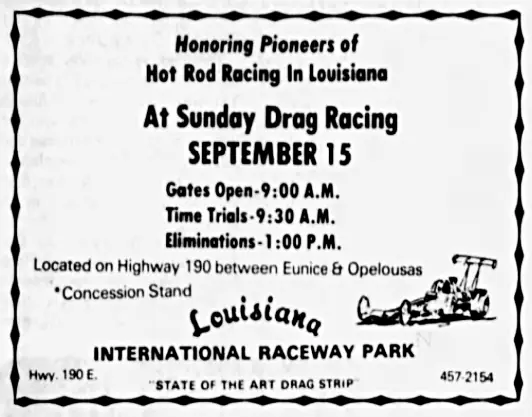
At the end of 1984 the twelve investors who had put up $700,000 moved to declare bankruptcy. Doucet, only a minor investor, took on all the debts and became sole owner. He said he wasn’t a rich man but had no choice except to raise the money, pay the bills and reopen, and he thought he could. He signed a deal with IHRA for a national event every year after 1986, and a small business loan gave him working capital for 1985. That season had weekly Sunday races, a two-day IHRA Winston World Title Series race in April, the Tri-Parish Fair, the Breaux Bridge Crawfish Festival, a three-day motorcycle drag race and a three-day truck and tractor pull. To avoid bankruptcy, the track was renamed Louisiana International Raceway Park in March 1985.
The first IHRA Bayou Nationals ran April 11-13, 1986. Mark Oswald set the track record in the opening round of Funny Car qualifying at 5.775 and 254.23 mph in the Candies & Hughes ‘Old Milwaukee’ Pontiac, with Ed McCulloch second. Bruce Allen was top Pro Stock qualifier. In 1987 CPAs Russell J. Stelly and Harold Dupre bought the strip, renamed it Louisiana Raceway Park and hired Gary Carter as manager. It ran until 2006, when it was sold for development.
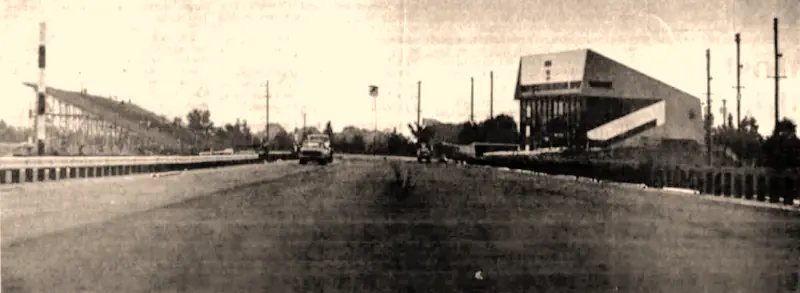
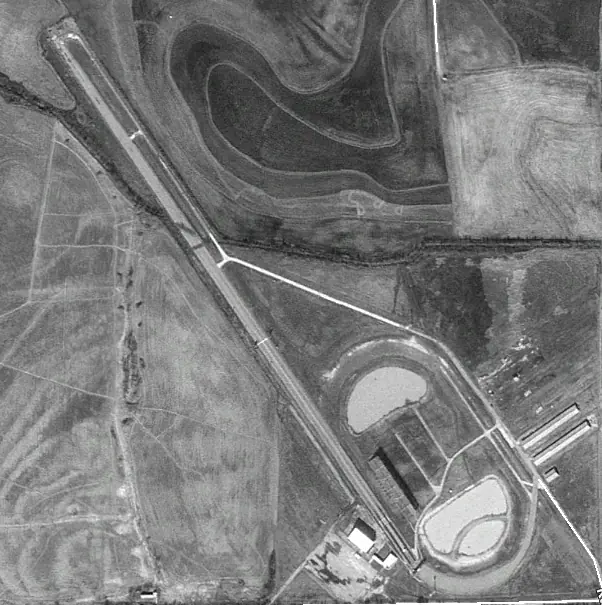
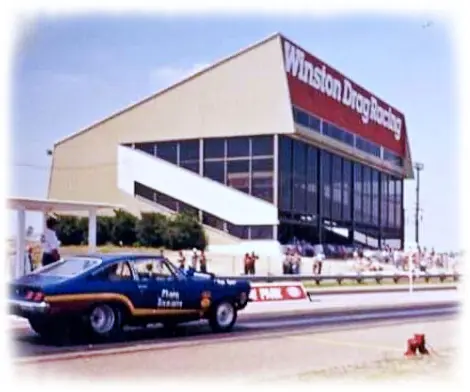
David Miller, who photographed at the track for a while, described it in the December 1985 Super Stock and Drag Illustrated. He placed it on 83 1/2 acres among bean fields just west of Opelousas and called it one of the most beautiful race plants in the world. The main building held suites, the timing tower, covered seating, a patio, concessions and offices, and a bridge crossed to the pits and a large grandstand at the starting line, with seating for 8,000 to 10,000. The pits had concrete roads, lakes and old stables turned into garages for the first hundred racers in. The strip was 75 feet wide between guardrails, with a 6-inch concrete bed under the asphalt and a steel-reinforced concrete starting pad 180 feet long and more than 6 inches thick.
More in Louisiana
- Nothing left No longer racing, and nothing of the track remains. Babin Landing Strip (Prairieville) 1980s
- Closed No longer racing, but some of the track is still there. Baton Rouge Dragway/State Capital Dragway (Erwinville) 1969-2025
- Active Still racing today. Bob Harmon Raceway/Twin City Dragway (Monroe) 1965-present
- Nothing left No longer racing, and nothing of the track remains. Cenla Raceway (Forest Hill) 1969-ca. 1977
- Closed No longer racing, but some of the track is still there. Crowley Drag Strip (Estherwood) 1964-67
- Closed No longer racing, but some of the track is still there. D'Arbonne Dragway (Farmerville) 1965-66
- Closed No longer racing, but some of the track is still there. De Soto Airport (Mansfield) 1954-62
- Closed No longer racing, but some of the track is still there. Esler Field (Pineville) 1956-57
- Closed No longer racing, but some of the track is still there. Estherwood Airport 1955, 1957
- Closed No longer racing, but some of the track is still there. Hammond Airport 1957-64
- Closed No longer racing, but some of the track is still there. Haynesville Dragway 1969-79
- Closed No longer racing, but some of the track is still there. Hilltop Raceway (Haughton) 1964-67