A & H Drag Strip (Fletcher)
Nothing leftNothing left No longer racing, and nothing of the track remains.
Also known as A & H Raceway Drag Strip
- Don Garlits helped design the two-lane layout
- 4,800 people came to the opening race
- The old airport control tower served as the timing tower
- Raced
- 1961-67
- State
- North Carolina
- What's left
- The site was redeveloped and nothing of the strip remains.
- On the site today
- Industrial park
- Raced on
- An airport runway
- First race
- April 23, 1961
- Last race
- 1967 (last documented)
- Track
- 1/4 mile
- Surface
- Runway
- Location
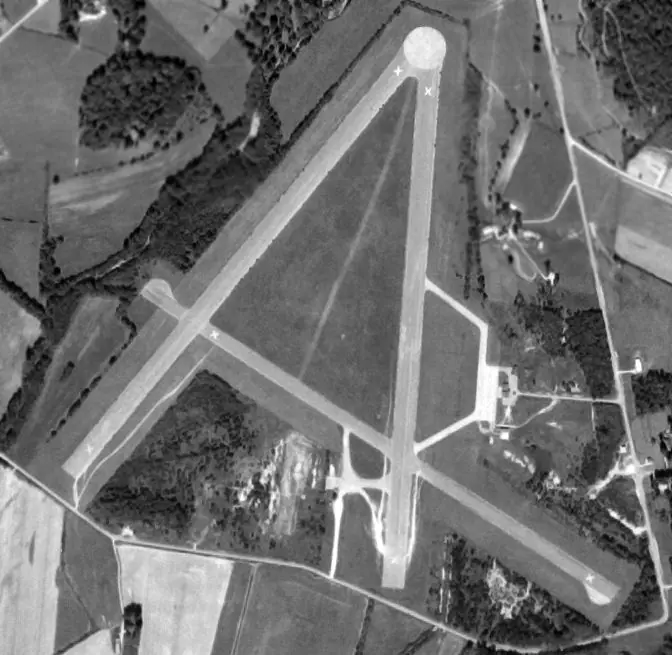
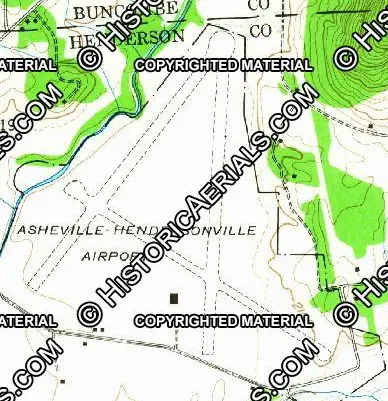
- Old Asheville-Hendersonville Airport, Fletcher
- People
- William C. Mason, head of Southeastern Enterprises, Inc., leaseholder (1961)
- Dewey Worley, strip manager (1961)
- Joe Taylor, promoter (1963)
- Sanction
- AHRA
- Elevation
- 2,087 ft (636 m)
- Coordinates
- 35.43883, -82.48020
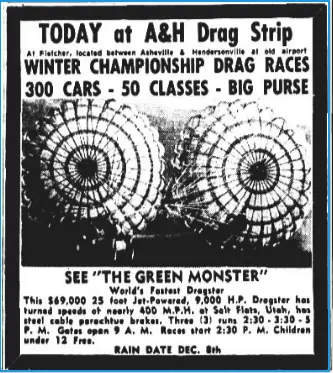
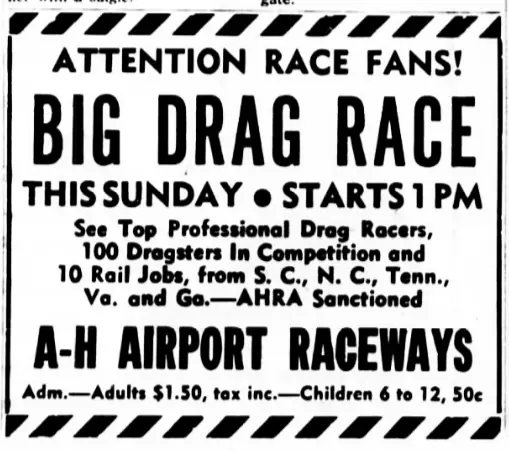
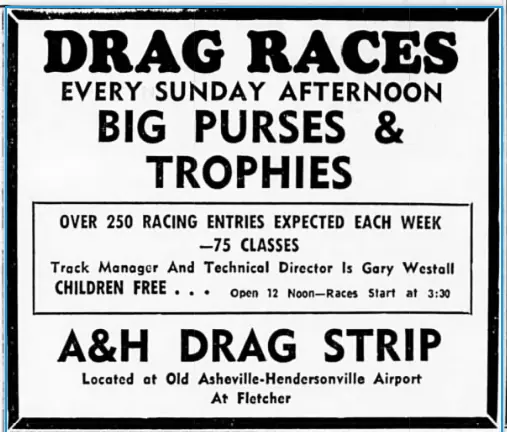
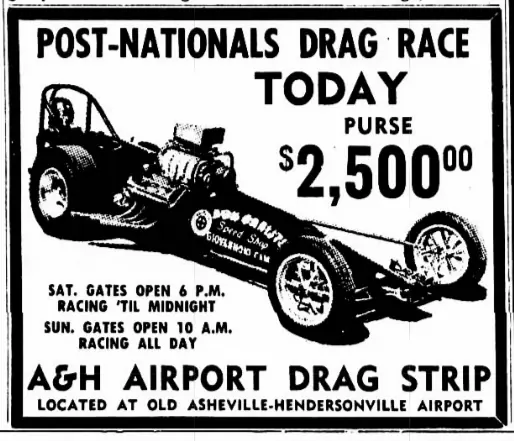
In mid-1959 the International Timing Association was negotiating to hold quarter-mile races at the old Asheville-Hendersonville Airport, hoping to start around March 1960. Racing didn’t come until the airport closed on January 15, 1961, put out of business by the new Asheville Regional Airport three miles west. A group of Asheville businessmen led by William C. Mason formed Southeastern Enterprises, Inc., leased the old field from Asheville, Hendersonville and Henderson County for $1,200 a month, and got AHRA sanction. Don Garlits helped lay out the two-lane strip on the long runway and called it one of the best in the country, saying the wide strip and long shutdown helped a driver’s confidence. Called A & H Raceway Drag Strip, it raced every Sunday, with Dewey Worley as manager and the old four-story control tower as the timing tower.
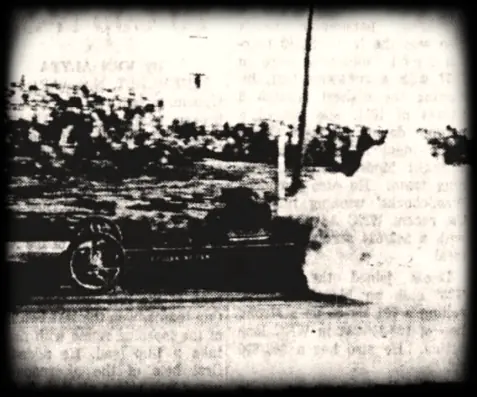
The first AHRA race ran April 23, 1961, and 4,800 people came despite early rain. “Sneaky” Pete Robinson tried out the track in his Atlanta dragster, and Hoyt Grimes, also of Atlanta, had top speed with a 9.6 at 165.74 MPH. The first night race under arc lights was March 31, 1962. Joe Taylor became promoter in 1963. On October 6, 1963, at the first annual Blue Ridge Invitational before 4,000 people, Gordon Collett was badly burned when his A/FD’s fuel tank burst at about 180 MPH. In 1964 the track raced Saturday nights and Sundays. It was on a 1968 list of 325 U.S. drag strips in the Swedish magazine Start & Strip, but newspapers show it running only through 1967. The land was rezoned commercial and after several years became an industrial park. An attempt to reopen the strip went nowhere, and racers sometimes broke through fences to race illegally, which made the site a nuisance. Henry Doriot has written about his memories of the strip in the early 1960s.